 comparison
High Volume Water Cooling: Is It Worth It for Data Centers?
Table of Contents
- Verdict: When High Volume Water Cooling Pays Off
- Water Cooling vs Air Cooling Efficiency: The Physics That Decides Your Bill
- How High Volume Water Cooling Improves PUE
- Data Center Water Usage Effectiveness: The Metric That Exposes Hidden Costs
- Industrial Water Supply for Data Centers: What Your Cooling Loop Actually Requires
- Retrofitting vs Greenfield: Where Water Cooling Makes Sense
- Maintenance, Compliance, and Operational Risks Nobody Prices In
- Conclusion: Running the Numbers Before You Commit
- Frequently Asked Questions
Last Updated: September 17, 2026
Verdict: When High Volume Water Cooling Pays Off
High volume water cooling is worth it for data centers when rack density climbs past the point where air can no longer carry the heat away, and when the site has a secure, high-volume water source to feed the loop. Below that threshold, air cooling still wins on cost and simplicity.
This guide from Our True North, LLC breaks down the physics, PUE math, and operational risks that decide whether a liquid loop pays for itself, which depends less on the technology than on rack density, climate, and water supply reliability.
Here's the core tension most vendor decks skip: water cooling is not automatically more efficient. It is more efficient at high heat density. Run a liquid loop on a half-empty rack and you have added pumps, plumbing, and maintenance for no gain.
Water Cooling vs Air Cooling Efficiency: The Physics That Decides Your Bill
Air is a poor conductor of heat. Water carries roughly 3,000 times more heat per unit volume, so a small chilled water loop can move thermal load that would require enormous volumes of conditioned air.
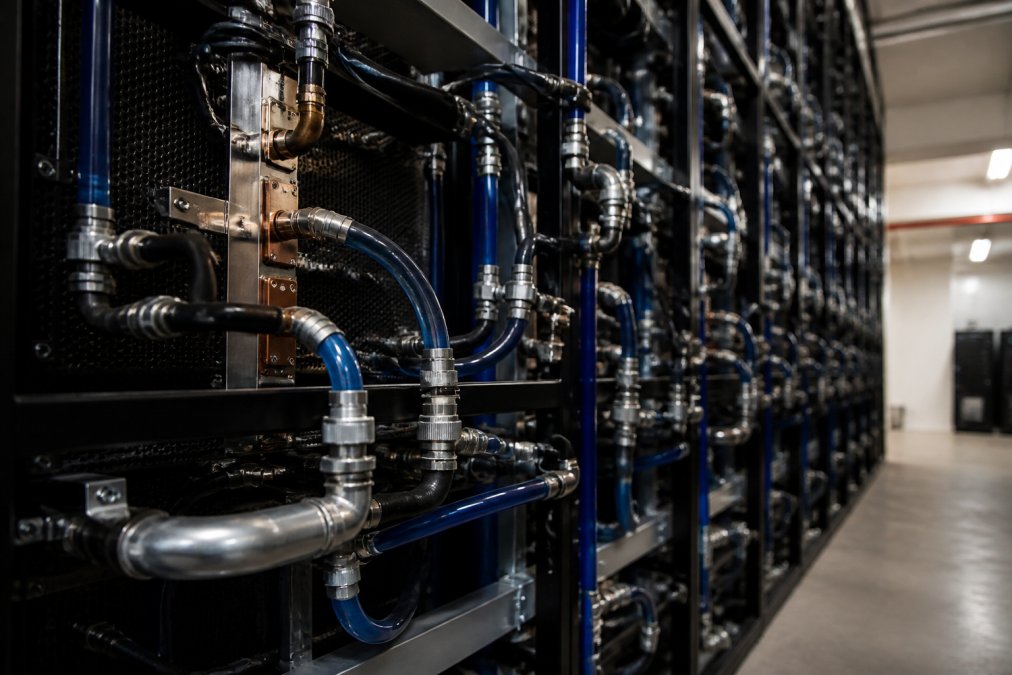
Liquid cooling removes heat at the source, at the chip, instead of cooling an entire room and hoping the hot air finds its way out.
- Air cooling relies on fans, CRAC units, and raised-floor airflow. It struggles above roughly 15-20 kW per rack.
- Liquid cooling uses cold plates or immersion to pull heat directly from components. It scales to 50 kW and beyond per rack.
- Hybrid approaches combine rear-door heat exchangers with air for a partial upgrade path.
How High Volume Water Cooling Improves PUE
Power Usage Effectiveness, or PUE, is the ratio of total facility power to the power delivered to IT equipment. A PUE of 1.0 is theoretically perfect; most air-cooled facilities run well above that because cooling overhead is significant.
| Cooling Approach | Typical PUE Range | Rack Density Ceiling | Best For |
|---|---|---|---|
| Traditional air | Higher overhead | ~15-20 kW | Legacy, low-density halls |
| Rear-door hybrid | Moderate | ~25-30 kW | Retrofits |
| Direct-to-chip liquid | Lower overhead | 50 kW+ | AI, HPC workloads |
| Immersion | Lowest overhead | 100 kW+ | Extreme density |
Data Center Water Usage Effectiveness: The Metric That Exposes Hidden Costs
Data center water usage effectiveness, or WUE, measures liters of water consumed per kilowatt-hour of IT load, the metric that turns water cooling's biggest selling point into its biggest hidden cost.
The trade-off is real:
- Closed-loop systems recirculate water and consume far less, but reject heat less efficiently.
- Evaporative systems consume more fresh water but achieve lower energy use.
- Hybrid designs balance the two based on seasonal ambient temperature.
Industrial Water Supply for Data Centers: What Your Cooling Loop Actually Requires
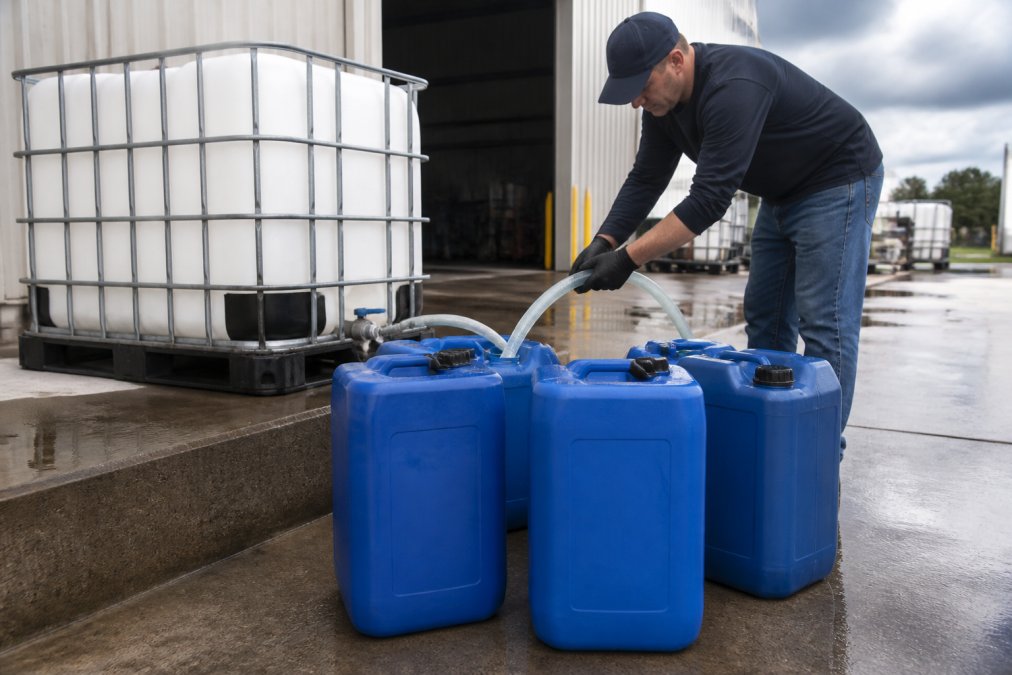
Industrial water supply for data centers is not a garden hose and a topping-off schedule. A high-volume cooling loop demands consistent quality, reliable volume, and a supply chain that does not fail during peak summer demand.
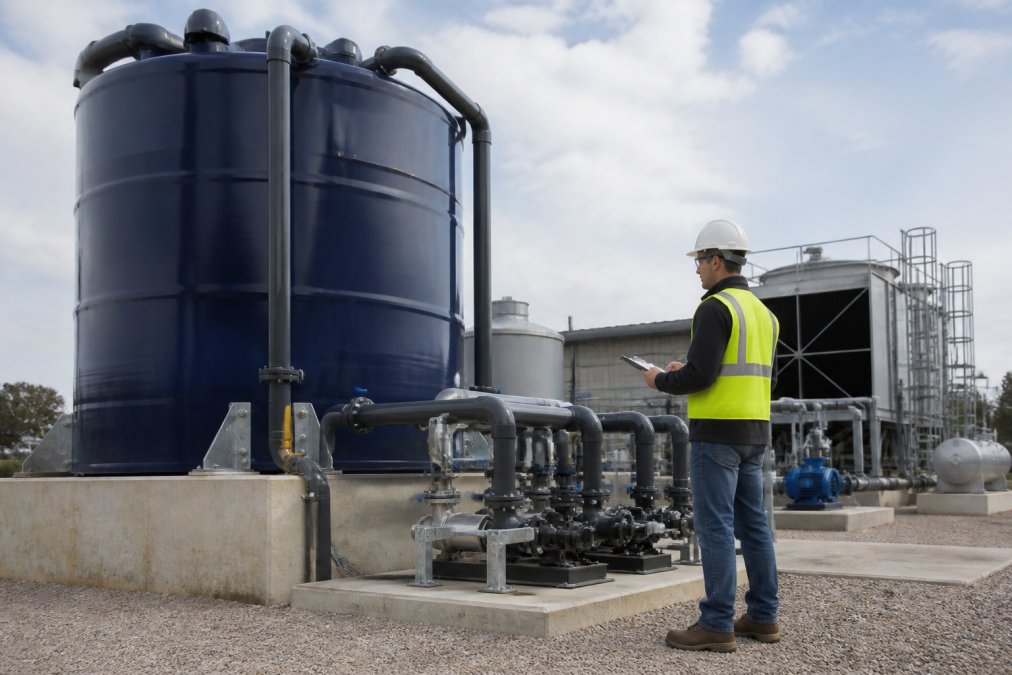
What a serious loop actually needs:
- Consistent volume sized to peak thermal load, not average
- Verified water quality that meets the cooling equipment's specification
- A supply model that survives demand spikes, when every facility in the region is pulling water at once
- Backup capacity so a single missed delivery does not stall operations
Retrofitting vs Greenfield: Where Water Cooling Makes Sense
Most articles frame liquid cooling as a technology choice. For an operator with an existing building, it is a construction and sequencing problem first: the question is rarely "is liquid better?" but "can this building accept a loop without a rebuild?"
- Floor loading. A filled coolant distribution unit (CDU), manifold piping, and a full immersion tank add substantial dead load. Many legacy raised-floor halls were not designed for that point loading, and structural reinforcement is a capital line item that rarely appears in vendor comparisons.
- Vertical clearance and routing. Cold-plate loops need supply and return manifolds above or below the rack. Overhead routing competes with existing cable trays and fire suppression; underfloor routing competes with the very air plenum you are trying to retire.
- CDU placement and heat rejection. A retrofit usually cannot reuse the existing chilled water plant at the temperatures a liquid loop wants. You either add a dedicated CDU with its own heat rejection, or you accept a warmer loop and lower efficiency.
- Leak detection and containment. Water above live equipment requires detection, isolation valves, and drip containment that a greenfield design bakes in from day one and a retrofit bolts on afterward.
- Phasing and uptime. You cannot take a revenue-generating hall offline to install a loop. Retrofits happen rack-by-rack, which means running air and liquid side by side for months and paying for both.
A practical decision framework:
- Greenfield with high density planned: Design for liquid now. The incremental cost of loop-ready infrastructure is small compared to retrofitting it later.
- Existing low-density hall, no density pressure: Stay on air. A retrofit here is capital spent to solve a problem you do not have.
- Existing hall with AI or HPC workloads incoming: Rear-door heat exchangers are the common bridge. They capture a meaningful share of rack heat into water without touching the servers, and they buy time while you decide on a full direct-to-chip or immersion path.
- Existing hall already near its air ceiling: Price the retrofit honestly, including structural, electrical, and phasing costs, before assuming liquid is cheaper than a new build.
- Multi-site operator: Standardize on one architecture where you can. Mixed cooling fleets multiply spares, training, and maintenance procedures.
Maintenance, Compliance, and Operational Risks Nobody Prices In
Liquid cooling adds an entire maintenance discipline air cooling does not have. Air cooling fails loudly and slowly, a fan spins down, a CRAC loses capacity, temperatures drift up and alarms fire. A liquid loop can fail quietly: a slow fitting weep, drifting coolant chemistry, a fouled cold plate that runs a few degrees warmer until it does not. Pricing that difference is where most total-cost comparisons fall apart.
- Leak detection tape and sensors at manifolds, CDUs, and rack inlets, tied to alarms and automatic isolation valves.
- Quick-disconnect fittings at the rack and server level so a component can be swapped without draining the loop.
- Drip containment and drainage below any wet path, sized so a fitting failure does not reach live equipment.
- Negative-pressure or low-pressure loop design where feasible, so a breach pulls air in rather than pushing fluid out.
- Documented response procedures and staff trained to execute them, because the first ten minutes of a leak determine the damage.
The operational risks that get underpriced:
- Loop downtime during maintenance windows, and the redundancy needed to avoid it.
- Coolant degradation quietly reducing heat transfer and raising chip temperatures before any alarm trips.
- Pump and CDU failure as a single point of failure if the loop is not designed with N+1 redundancy.
- Supply interruption if the water source cannot meet peak demand during a regional heat event.
- Staff training for a system your team has never operated, including chemistry, leak response, and CDU service.
Conclusion: Running the Numbers Before You Commit
The honest answer to whether high volume water cooling is worth it comes down to three variables: rack density, climate, and water supply reliability. High density in a hot region with a secure water source makes liquid the clear winner; low density in a mild climate makes it an expensive answer to a problem you do not have.
Frequently Asked Questions
What is the best cooling system for a data center?
There is no universal best system. Air cooling works for racks under roughly 15 kW. Above that, direct-to-chip liquid cooling or immersion cooling becomes more efficient. The right choice depends on your rack density, climate, water availability, and whether you are building new or retrofitting. Hybrid designs, where liquid handles high-heat processors and air handles the rest, are common in 2026.
Why do data centers need so much water for cooling?
Evaporative cooling systems reject heat by evaporating water, which is thermodynamically efficient but consumes large volumes. A mid-size facility using evaporative towers can consume hundreds of thousands of gallons per day in summer. Closed-loop liquid cooling uses far less water because the same fluid recirculates, but it still requires makeup water for leaks and maintenance.
How does high volume water cooling improve PUE?
Water carries heat roughly 3,500 times better than air by volume, so it removes heat at the source instead of cooling an entire room. That reduces fan energy, compressor load, and chilled water pumping. Facilities moving from air-only to direct-to-chip liquid cooling commonly see PUE drop from around 1.5 to between 1.1 and 1.2, depending on climate and design.
What are the downsides of water cooling?
Higher capital expenditure, specialized plumbing, leak detection requirements, and maintenance protocols top the list. Retrofits are disruptive because existing racks may not support cold plates or manifolds. Water quality also matters: poor water chemistry causes scale, corrosion, and biofilm that shorten equipment life. Operators must budget for filtration, testing, and trained staff.
Is liquid cooling more energy-efficient than traditional air cooling?
Yes, in high-density environments. Direct-to-chip liquid cooling can significantly improve energy efficiency compared to air-only cooling. The advantage grows as rack power density rises. At low densities, the efficiency gap narrows and the added infrastructure cost may not justify the switch.