 comparison
Uph2o Alternative: High-Volume Water for Industrial Sites
Table of Contents
- Why Industrial Facilities Are Searching for an Uph2o Alternative
- Comparing Your Options: A Quick Look at Water Supply Models
- How to Evaluate an Industrial Bulk Water Delivery Partner
- Solving Water Supply Logistics for Data Centers
- Choosing the Right Pickup Model for Your Facility
- High-Volume Water Procurement Strategies for Consistent Supply
- Make the Switch: A Simple Plan for Your Site
- Frequently Asked Questions
Last Updated: September 7, 2026
Why Industrial Facilities Are Searching for an Uph2o Alternative
Finding a reliable uph2o alternative for industrial sites often comes down to one core issue: delivery dependency. When your facility depends on scheduled truck arrivals for process water, cooling tower makeup, or crew hydration, any delay in that schedule becomes your operational problem. A missed delivery window can stall a data center's cooling loop or leave a construction site without potable water during peak heat.
For high-volume users, the answer to that question determines whether you experience unplanned downtime or maintain continuous output.
The most effective uph2o alternative isn't necessarily a different chemical treatment or filtration technology. It's a different supply model, one built around predictable pickup rather than reactive delivery. Below, we'll show you exactly how to evaluate that model against your facility's volume requirements and daily reliability needs.
Comparing Your Options: A Quick Look at Water Supply Models
Industrial water procurement generally falls into three models: delivered bulk water, point-of-use filtration, and pickup-based supply. Each serves a different operational profile, and the right choice depends on your consumption rate, facility layout, and tolerance for supply chain variability.
Delivered bulk water works well for sites with storage capacity and flexible scheduling, but it ties your uptime to a third party's logistics. Point-of-use filtration systems, such as bottleless purification units, eliminate storage and delivery entirely by treating water at the tap, though they require professional installation and plumbing access. Pickup-based supply, the model gaining traction among Texas industrial operators, puts your team in control of timing.
| Supply Model | Best For | Key Trade-Off |
|---|---|---|
| Delivered bulk water | Sites with storage and flexible schedules | Dependent on third-party delivery windows |
| Point-of-use filtration | Facilities with existing plumbing infrastructure | Requires installation and ongoing maintenance |
| Pickup-based supply | High-volume users needing schedule control | Requires staff time for transport |
How to Evaluate an Industrial Bulk Water Delivery Partner
Selecting a bulk water supplier for an industrial site is a procurement decision with operational, regulatory, and financial consequences. A low per-gallon price is meaningless if the water chemistry is unstable, the supplier lacks redundancy, or the contract locks you into terms that fail under peak demand. A rigorous evaluation process must go beyond a quote and assess the supplier's ability to meet your specific process requirements under real-world conditions.
Step 1: Audit Your Water Quality Specifications
Before contacting suppliers, document the water quality parameters your operations actually require. For cooling tower makeup, you need water with low scaling potential, typically low hardness, alkalinity, and silica. For boiler feed, you need water with very low total dissolved solids (TDS) to prevent scale and corrosion. For potable use, you need water that meets the EPA's National Primary Drinking Water Regulations (the EPA).
Your audit should specify:
- pH range: Most industrial processes operate best within a pH of 6.5 to 8.5, but specific applications may require tighter control.
- Total dissolved solids (TDS): High TDS accelerates scaling in heat exchangers and increases blowdown frequency.
- Hardness (as CaCO3): Hard water above 150 ppm requires softening for most boiler and cooling applications (energy.gov).
- Chlorides and sulfates: These ions are corrosive to stainless steel and other metals; limits depend on your metallurgy.
- Microbiological content: For potable use, the water must be free of coliform bacteria and meet EPA standards for pathogens.
Step 2: Request and Verify the Supplier's Water Quality Data
A reputable supplier will provide a current Certificate of Analysis (COA) from a certified laboratory. Do not accept verbal assurances. The COA should be dated within the last 90 days and should list the specific parameters you identified in your audit.
Ask these direct questions:
- What is the source of the water? Municipal supply, well water, or treated surface water each have different chemical profiles and variability.
- How often is the water tested? Monthly testing is a minimum standard; weekly testing is preferable for variable sources.
- What is the documented range of pH and TDS across the last 12 months? A single COA tells you nothing about seasonal variability.
- Does the supplier have a treatment process? If so, what is it? Reverse osmosis, ion exchange, and UV disinfection are common; each has different failure modes.
- Can the supplier provide a letter of guarantee for water quality? If they cannot, that is a red flag.
Step 3: Assess Supply Reliability and Redundancy
Your facility's uptime depends on the supplier's ability to deliver consistent volume, not just consistent quality. Evaluate their infrastructure:
- How many source wells or supply points do they operate? A single source is a single point of failure.
- What is their storage capacity? A supplier with on-site storage tanks can buffer against source disruptions.
- Do they have backup power for their pumping systems? A supplier without generator backup is vulnerable to grid outages.
- What is their historical on-time pickup record? Ask for a reference from an existing industrial customer with similar volume requirements.
Step 4: Run a Pilot Test Before Committing
A contract is not the time to discover that the water chemistry is wrong or the pickup process is unworkable. Run a pilot program for at least 30 days. During the pilot:
- Test every load for pH, TDS, and hardness. Log the results and compare them against your specifications.
- Measure total pickup cycle time from departure to return. This includes travel, loading, and any queuing at the supplier's facility.
- Document any water quality excursions. If the supplier's water varies beyond your tolerance, that is a disqualifying finding.
- Verify volume accuracy. Confirm that the amount you pay for matches the amount you receive. A discrepancy of more than 2% is a red flag.
Step 5: Review the Contract for Operational Traps
Before signing, have legal counsel review the supply agreement for these common issues:
- Minimum purchase requirements: A monthly minimum that exceeds your average demand forces you to buy water you do not need.
- Force majeure clauses: These typically excuse the supplier from performance during events beyond their control. Ensure the clause does not allow them to suspend service for routine maintenance or equipment failure.
- Price escalation terms: Understand how and when the supplier can raise prices. Indexing to fuel costs is common; indexing to a vague 'market conditions' clause is a risk.
- Termination penalties: You need the flexibility to switch suppliers if performance degrades. A termination penalty that exceeds two months of service cost is excessive.
The Financial Case for Rigorous Evaluation
The cost of a failed supplier relationship is not just the contract value. It includes:
- Unplanned downtime: For a data center, an hour of downtime can cost tens of thousands of dollars in lost revenue and penalties (datacenters.lbl.gov).
- Equipment damage: Poor water chemistry can scale a heat exchanger or corrode a boiler, leading to repair or replacement costs that dwarf any water savings.
- Regulatory noncompliance: If your discharge water fails to meet your National Pollutant Discharge Elimination System (NPDES) permit limits because of a change in your makeup water chemistry, you face fines and potential legal action.
A rigorous evaluation process is an insurance policy against these risks. The time spent auditing suppliers before signing a contract is a fraction of the time required to unwind a bad agreement. For most industrial facilities, the evaluation process takes two to four weeks and involves the facility manager, the procurement team, and the environmental health and safety (EHS) officer. That investment is justified by the certainty it provides.
Solving Water Supply Logistics for Data Centers
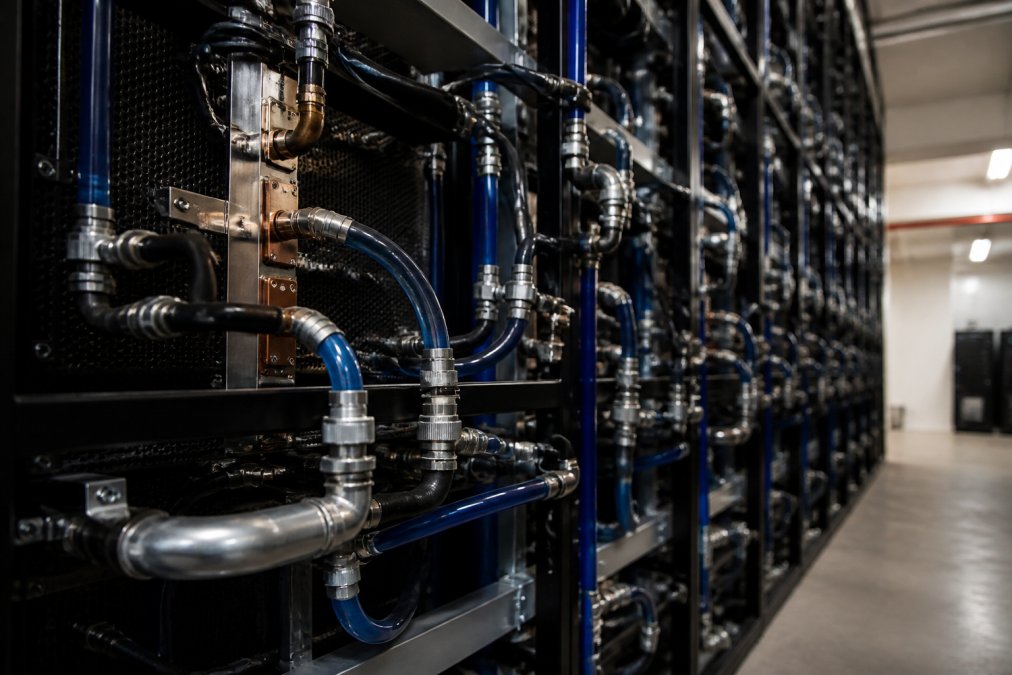
Data center operations present the most demanding water logistics scenario because cooling loops run continuously and cannot pause for a supplier's schedule. A 24/7 facility needs a water supply model that matches that uptime commitment, and delivery-based systems introduce a failure point that no redundancy plan fully eliminates.
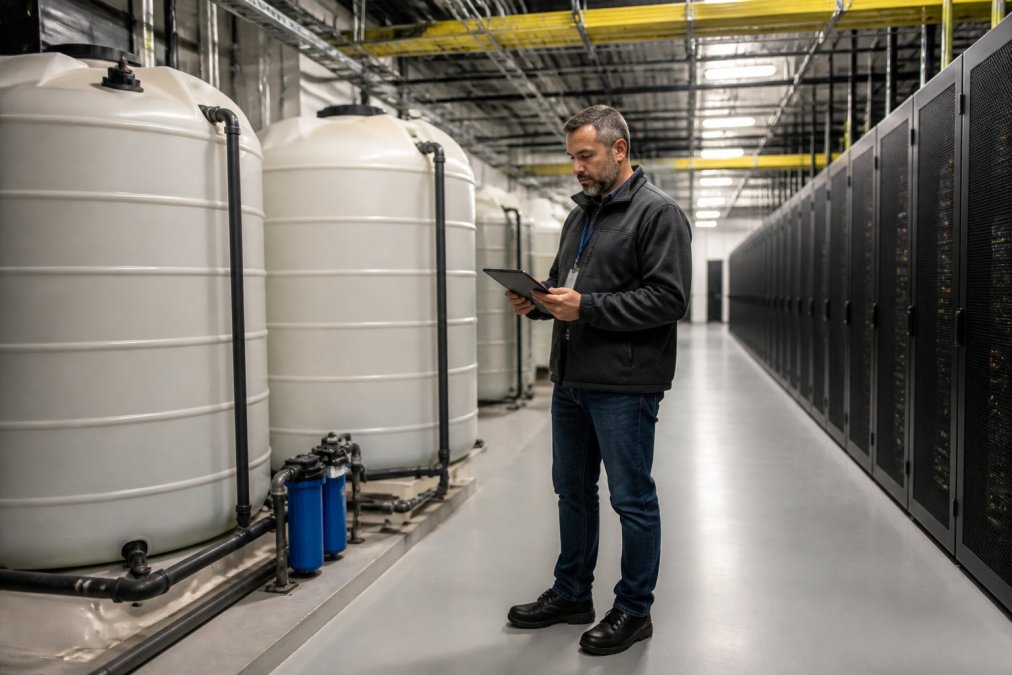
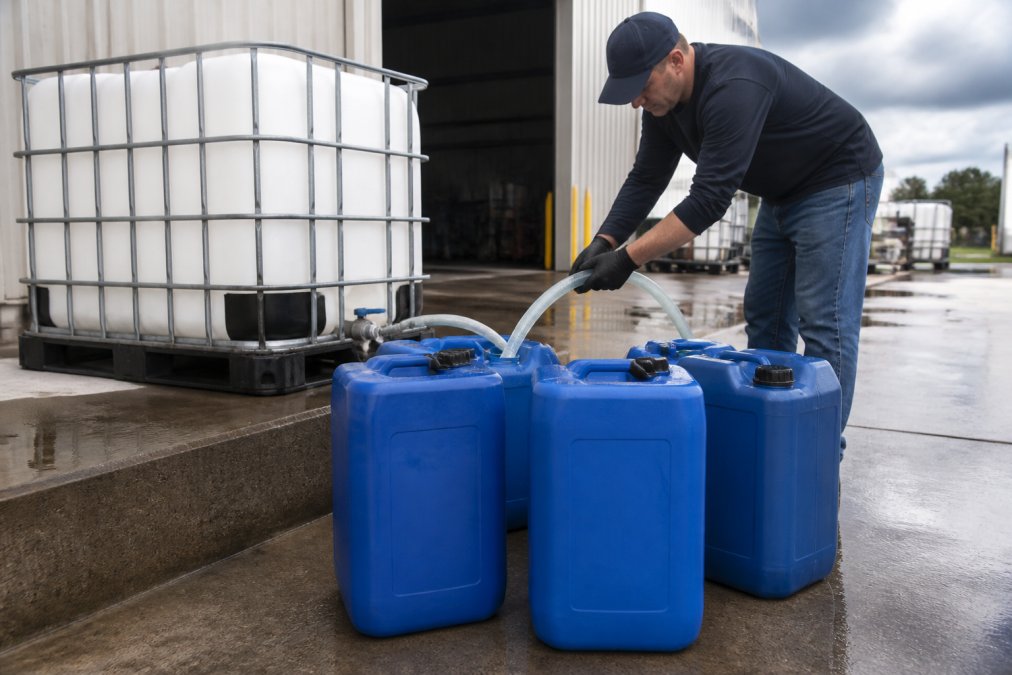
Pickup-based procurement solves this by decoupling water availability from delivery routes. Your team controls when water is collected, so you can schedule pickups during off-peak hours or build buffer inventory ahead of forecasted heat waves. This approach also simplifies water supply logistics for data centers because it reduces the coordination burden between your facility manager and an external dispatch team.
For facilities concerned about summer demand spikes, the solution is disciplined inventory management. Calculate your daily evaporation and blowdown rates, add a safety margin for peak ambient temperatures, and establish a minimum tank level that triggers a pickup request. This turns water procurement from a reactive scramble into a scheduled operational task.
Choosing the Right Pickup Model for Your Facility
The pickup model works best for facilities with dedicated staff who can manage a recurring transport task. It is less suitable for sites operating with minimal crew coverage or those lacking appropriate vehicle capacity for high-volume transport.
A practical middle ground is a hybrid approach: maintain a base inventory through scheduled pickups, and keep an emergency supplier relationship for unplanned spikes. This preserves the schedule control of pickup while retaining a backup for exceptional circumstances. Facilities typically find that a consistent pickup schedule, combined with a modest storage buffer, eliminates most emergency scenarios entirely.
When evaluating whether pickup suits your operation, consider three factors: staff availability for transport, storage capacity on site, and the distance to your water source. A site within reasonable driving distance of a reliable source, with one staff member who can dedicate an hour per pickup, can usually transition successfully without adding headcount.
High-Volume Water Procurement Strategies for Consistent Supply
High-volume water procurement strategies should center on building redundancy into your supply chain rather than relying on a single source. Even the most reliable supplier can face equipment failure or weather disruption, so your strategy needs a secondary option that can be activated quickly.
Implement a tiered approach: your primary source handles regular scheduled volume, while a secondary source covers overflow and emergency needs. Establish both relationships before you need them, because negotiating supply agreements during a crisis rarely produces favorable terms. Document water quality parameters for both sources so you can switch without re-qualifying your process.
Consider also whether your facility can reduce total water demand through operational changes. Cooling tower optimization, leak detection programs, and condensate recovery can lower your required procurement volume, which in turn reduces the frequency of pickups and your exposure to supply interruptions. These efficiency measures complement any procurement strategy by shrinking the volume you need to source.
Make the Switch: A Simple Plan for Your Site
Transitioning from a delivery-dependent model to a pickup-based uph2o alternative follows a straightforward sequence. First, document your current consumption patterns across a full month, noting peak usage days and seasonal variations. Second, calculate the storage capacity you need to maintain a safe buffer between pickups. Third, identify a supplier who can verify water quality documentation and accommodate your volume requirements.
Our True North, LLC supports this transition with a simple pickup process designed to eliminate delivery delays for critical projects. Based in Rising Star, Texas, we provide high-volume alkaline water for data centers, construction crews, industrial sites, and fire departments, with a flexible pickup schedule that fits your operational rhythm. Our model puts schedule control back in your hands, so your facility's water supply never depends on someone else's route.
The switch requires an upfront investment of staff time and planning, but the payoff is predictable supply and fewer unplanned interruptions. Start with a trial pickup to validate the workflow, then scale your schedule as confidence grows. For facilities where uptime is non-negotiable, a pickup-based model offers the control that delivery logistics cannot match.
Frequently Asked Questions
What makes a pickup-based model a viable Uph2o alternative for industrial sites?
A pickup model eliminates delivery delays, the most common point of failure for industrial water supply. You control the schedule, which means you are not waiting on a truck that is stuck in traffic or behind schedule. For facilities with tanker access and staff who can manage the process, it offers a reliable, consistent supply. This method works well for sites that plan ahead and need a dependable source without the logistics of scheduled delivery windows.
How does water quality affect industrial equipment longevity?
Water quality directly impacts equipment lifespan. High mineral content causes system scaling in boilers and cooling towers, reducing efficiency and leading to premature failure. Contaminants can foul membranes in reverse osmosis systems and corrode pipes. Using water that meets your specifications protects capital investments, reduces maintenance frequency, and ensures consistent operational efficiency. Verifying your source's water quality metrics is a critical step in any high-volume water procurement strategy.
What criteria should be used to evaluate an industrial bulk water delivery partner?
Evaluate potential partners on consistency, quality, and volume capacity. Ask for water quality reports to ensure the supply meets your equipment specifications. Confirm they can handle your peak demand, especially during summer months. Assess their operational model: does it fit your logistics? For a pickup model, verify that their location and hours work for your team. Reliability and a straightforward process are more valuable than minor price differences.
Are there local alternatives to Uph2o for high-volume water needs?
Yes, local providers can offer significant advantages. A nearby source reduces travel time for pickup, making the process more efficient for your staff. Local companies often provide more flexible scheduling and direct communication. When researching an Uph2o alternative, ask about their source, treatment process, and testing procedures. A provider with a local presence can offer a level of responsiveness that is difficult for larger, more distributed operations to match.
Finding the right water supply model for your industrial site ultimately comes down to control and consistency. If your current arrangement leaves you vulnerable to delivery delays or uncertain water quality, a pickup-based approach from Our True North, LLC offers a dependable path forward with high-volume alkaline water and a schedule you manage. Get a free estimate and see how a simple pickup process can keep your operations running without interruption.