 ultimate-guide
Maintaining Water Quality for Operations: A 2026 Guide
Table of Contents
- Why Water Quality Management Is a Business Imperative
- The Real Impact of Water Quality on Industrial Equipment
- Core Components of a Water Treatment Process for Operations
- Proactive vs. Reactive Maintenance: A Cost-Benefit Analysis
- Water Quality Monitoring Best Practices for Continuous Operations
- Evaluating Industrial Water Treatment Alternatives
- The Role of Digital Tools and IoT in Maintaining Water Quality
- Building a Contingency Plan for Water Quality Failures
- Conclusion
- Frequently Asked Questions
Last Updated: September 6, 2026
Why Water Quality Management Is a Business Imperative
Water quality management is the systematic process of monitoring, treating, and maintaining water to meet specific operational standards. For industrial facilities, data centers, and commercial operations, this discipline directly determines equipment lifespan, regulatory standing, and production uptime.
The stakes extend far beyond simple cleanliness. Poor source water introduces impurities that accelerate corrosion, encourage microbial growth, and drive system scaling throughout piping and heat exchange equipment. These failures rarely announce themselves gradually. They surface as sudden pressure drops, fouled filtration systems, or complete pump failures during peak operational windows.
What many operations managers miss is that water quality is not a single checkpoint but a continuous condition. It shifts with seasonal source changes, equipment modifications, and even weather patterns. Below, we'll show you exactly how to build a maintenance framework that protects your infrastructure, your compliance standing, and your bottom line.
The Real Impact of Water Quality on Industrial Equipment
Equipment degradation from poor water quality is the silent budget killer most facilities never trace back to its source. Scale buildup inside pipes acts as insulation, forcing pumps and heat exchangers to work harder while transferring less energy. Over time, this inefficiency compounds into higher utility bills and premature component failure.
Corrosion presents an equally serious threat. When dissolved oxygen, chlorides, or pH imbalances go unaddressed, metal surfaces deteriorate from the inside out. Pinhole leaks in critical lines often require emergency shutdowns that halt entire production runs. The cost of replacing a single heat exchanger or chiller barrel far exceeds the expense of a disciplined treatment program.
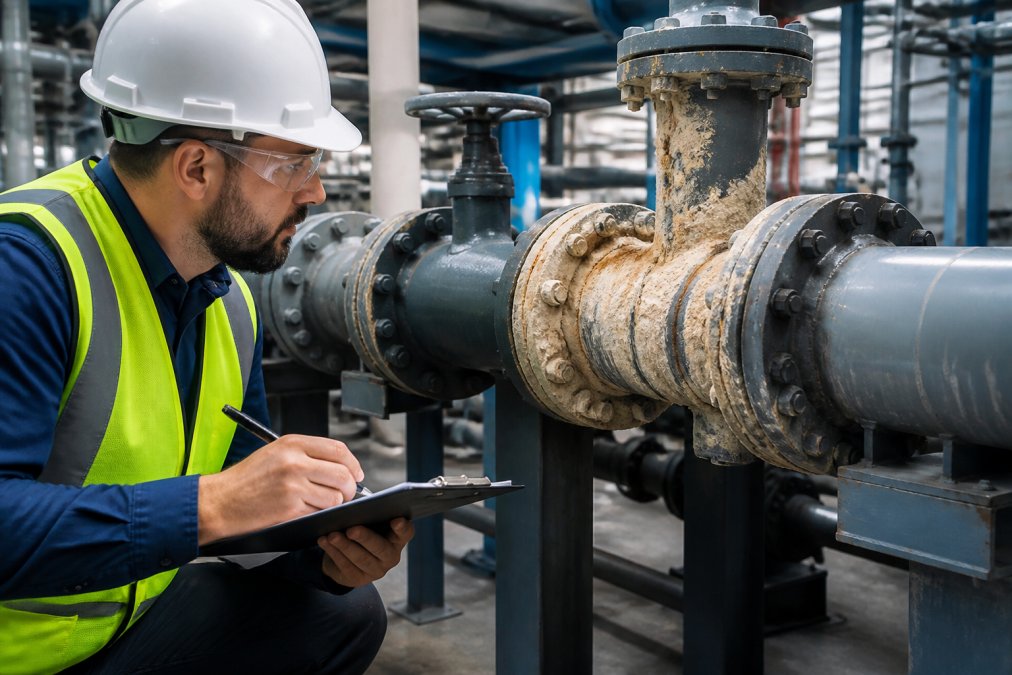
Microbial growth adds a third layer of risk. Biofilms inside cooling towers and storage tanks shelter bacteria that accelerate corrosion and clog fine filtration systems. For food and beverage operations, biological contamination also threatens product safety and brand reputation. Consistent testing for turbidity, pH levels, and dissolved oxygen catches these problems before they become visible.
Core Components of a Water Treatment Process for Operations
An effective water treatment process for operations combines several stages tailored to the facility's specific source water and end-use requirements. No single technology solves every water quality challenge, which is why understanding the full treatment chain matters.
Filtration systems remove suspended solids and larger particulates before they reach sensitive equipment. Depending on your source, this may involve sediment filters, multimedia beds, or membrane systems. Following filtration, chemical dosing adjusts pH levels and introduces inhibitors that prevent scaling and corrosion within the system.
For many operations, water purification through reverse osmosis or deionization delivers the high-purity output that data centers and industrial boilers demand. These technologies strip dissolved minerals and contaminants that cause deposits on heat transfer surfaces. The final stage often includes polishing filters and UV treatment to control microbial growth and ensure the water meets effluent standards before discharge or reuse.
A common mistake is treating these stages as optional checkboxes rather than an integrated sequence. Each component protects the next, and skipping one stage forces downstream equipment to work harder, shortening its service life.
Proactive vs. Reactive Maintenance: A Cost-Benefit Analysis
Most facilities default to reactive maintenance because the cost of inaction is invisible until failure occurs. The math rarely supports that approach. Proactive maintenance converts unpredictable emergency spending into predictable, budgetable operating expenses.
Consider the cost structure. Reactive repairs include emergency labor rates, expedited parts shipping, and lost production during unscheduled downtime. Proactive programs spread costs across routine inspections, scheduled filter changes, and consistent chemical testing. When you compare annual totals, the proactive approach typically costs a fraction of a single major failure event.
The operational benefits extend beyond direct savings. Scheduled maintenance gives you control over when systems go offline, allowing work during low-demand windows rather than crisis moments. It also extends asset longevity, delaying capital replacement cycles and improving the accuracy of your depreciation forecasts.
Water Quality Monitoring Best Practices for Continuous Operations
Water quality monitoring best practices center on frequency, consistency, and documentation. Testing once per quarter is insufficient for any operation that runs continuously. Daily or weekly checks of critical parameters catch developing problems while they are still correctable.
Build your monitoring schedule around your risk profile. Facilities using municipal water may test weekly for pH, conductivity, and chlorine residual. Operations drawing from wells or surface water should test more frequently, especially after heavy rainfall or seasonal changes. Track turbidity, dissolved oxygen, and microbial counts to establish baseline trends for your specific source.
Documentation is as important as the testing itself. Maintain logs that record every reading, treatment adjustment, and maintenance action. These records support compliance reporting, help you spot gradual trends before they become failures, and provide evidence of due diligence during regulatory inspections.
| Monitoring Parameter | Recommended Frequency | Primary Risk It Detects |
|---|---|---|
| pH levels | Daily | Corrosion or scaling potential |
| Conductivity/TDS | Daily | Dissolved solids buildup |
| Turbidity | Weekly | Filter breakthrough, sediment |
| Microbial counts | Weekly | Biofilm formation |
| Dissolved oxygen | Weekly | Corrosion acceleration |
Evaluating Industrial Water Treatment Alternatives
Operations managers evaluating industrial water treatment alternatives must weigh source reliability against treatment complexity, capital costs against operating expenses, and control against convenience. There is no universally correct answer; the right choice depends on facility size, water demand, space constraints, and the criticality of the operation. A structured evaluation framework helps avoid the common mistake of selecting a solution based on per-gallon price alone.
On-site treatment systems offer the greatest degree of control. A facility that owns its treatment infrastructure, whether that is a media filtration system, a reverse osmosis unit, or a full chemical dosing program, can adjust parameters in real time and is not dependent on a supplier's schedule. The capital cost for a mid-sized industrial system depends on capacity and complexity. Operating costs include chemical consumption, electricity for pumps and controls, replacement filters and membranes, and labor for monitoring and maintenance. For a facility with stable, predictable water demand, the per-gallon cost of on-site treatment is often lower than delivered water, and the facility retains full control over quality.
The operational burden of on-site systems is frequently underestimated. Chemical storage requires dedicated space with secondary containment to meet environmental regulations. Trained personnel must be available to calibrate sensors, adjust dosing rates, and respond to alarms, often across multiple shifts. Membrane systems require periodic cleaning and eventual replacement, with RO membranes typically lasting 3 to 5 years depending on feed water quality. Facilities that lack in-house technical expertise may find that the cost of a service contract for maintenance erodes the savings of owning the system.
Delivery-based models eliminate treatment infrastructure entirely. Water arrives pre-treated and tested, ready for direct use in cooling systems, boilers, or process lines. This approach suits facilities where space is limited, where water demand fluctuates seasonally, or where the capital budget for treatment equipment is not available. The trade-off is dependence on a supplier's consistency and delivery schedule. A facility that requires 5,000 gallons per week must be confident that the supplier can deliver on time, every time, and that the delivered water consistently meets the agreed-upon quality specifications. Per-gallon costs for delivered water can vary compared to on-site treatment, but the total cost of ownership may be lower when labor, maintenance, and capital depreciation are factored in.
A third option combines both approaches: treat municipal water on-site for general use while reserving delivered high-purity water for critical applications. This hybrid strategy provides redundancy and flexibility. Many data centers and industrial sites in Texas have adopted hybrid models to protect against supply interruptions during peak summer demand. The on-site system handles the base load, while the delivered water serves as a backup and as a source for applications requiring the highest purity. This approach also provides a natural testing mechanism, comparing the quality and cost of the two sources over time can inform future decisions about expanding or contracting the on-site system.
Risk assessment should be part of the evaluation. What happens if the on-site system fails? How quickly can a replacement part be sourced? What happens if the delivery truck is delayed by weather or a supply chain disruption? Facilities that treat water as a critical input, like electricity or compressed air, should build redundancy into their plan, whether that means a backup supply agreement, a spare pump, or a second treatment train. The cost of redundancy is an insurance premium against downtime, and the premium is almost always less than the cost of an unplanned shutdown.
The Role of Digital Tools and IoT in Maintaining Water Quality
Maintaining water quality for operations has entered the era of continuous digital oversight. IoT sensors now track pH, conductivity, turbidity, and flow rates in real time, transmitting data to centralized dashboards that alert operators the moment a parameter drifts outside acceptable ranges. This shift from periodic sampling to real-time monitoring transforms how facilities respond to emerging issues.
The practical advantage is speed. A sensor detecting a pH excursion at 2:00 AM triggers an immediate alert, allowing an on-call technician to adjust chemical dosing before scale forms or corrosion begins. Without this visibility, the same excursion might go unnoticed for days, silently damaging equipment. According to industrial IoT case studies on predictive maintenance, connected monitoring systems help facilities reduce unplanned downtime by identifying issues while they are still minor.
Digital tools also strengthen compliance reporting. Automated logs eliminate transcription errors and provide auditors with a complete, timestamped record of water quality data. This transparency simplifies regulatory compliance and demonstrates due diligence. For multi-site operations, centralized dashboards allow managers to compare performance across locations and standardize treatment protocols.
EPA guidance on water efficiency and management emphasizes that understanding your water systems and monitoring their performance is foundational to sustainable water resource management. Digital monitoring makes that understanding continuous rather than episodic.
Building a Contingency Plan for Water Quality Failures
Every operation needs a documented response plan for the day water quality fails. The plan should name specific triggers, assign responsibilities, and establish communication protocols before an incident occurs, not during one.
Start by identifying your single point of failure. If your primary treatment system goes offline, what is your backup? Many facilities maintain an emergency water supply agreement with a secondary provider who can deliver pre-treated water on short notice. This redundancy protects against both equipment failure and source water contamination events.
Define clear escalation procedures. A minor conductivity drift may only require adjusting chemical dosing. A positive microbial test demands immediate system shutdown, flushing, and disinfection before production resumes. Your team needs unambiguous thresholds that distinguish between routine adjustments and emergency responses.
As documented in FEMA guidance on business emergency planning, organizations that prepare contingency plans recover faster and face lower overall losses when disruptions occur. Water quality failures are no exception to this principle.
Conclusion
Water quality management is not a maintenance task; it is a risk management discipline that protects your equipment, your compliance standing, and your operational continuity. The choice between proactive monitoring and reactive repair is really a choice between predictable costs and emergency spending. Our True North, LLC supports high-volume operations across Texas with clean alkaline water and a simple pickup process that eliminates delivery delays. Get a free estimate from Our True North, LLC and secure a water supply that keeps your operations running.
Frequently Asked Questions
What are the primary indicators of water quality for industrial operations?
Key indicators include pH levels, turbidity, dissolved oxygen, conductivity, and the presence of specific contaminants like microbial growth or dissolved solids. For industrial systems, scaling potential and corrosion rates matter more than potability standards. Monitoring these parameters helps you detect shifts before they damage equipment. Your testing frequency should align with your water source and operational demands. A baseline assessment establishes normal ranges for your facility, making deviations easier to spot.
How does poor water quality lead to operational downtime?
Poor water quality causes scale buildup, corrosion, and microbial growth inside pipes, heat exchangers, and cooling towers. This degradation reduces heat transfer efficiency, forces pumps to work harder, and eventually triggers component failure. Unplanned shutdowns for repairs or replacement disrupt production schedules and carry higher costs than scheduled maintenance. Real-time monitoring with alert thresholds helps you address issues before they escalate into system failures.
What should a water quality monitoring schedule include?
A practical schedule combines online sensors for continuous tracking with periodic laboratory testing for verification. Test pH, conductivity, turbidity, and microbial counts daily or weekly depending on system sensitivity. Schedule full laboratory analysis quarterly to detect trace contaminants and confirm sensor accuracy. Document all results and corrective actions for compliance reporting. Your schedule should also include immediate testing after any significant change in source water or process operations.
How can high-volume operations secure consistent water quality?
High-volume operations need a supply partner who understands industrial specifications, not just potable standards. Look for a provider offering documented water quality data and the capacity to meet peak demand. A reliable pickup model eliminates delivery delays and gives you control over scheduling. Ask about testing protocols and source consistency before committing. Your contingency plan should name an alternative supplier in case your primary source experiences an interruption.