 ultimate-guide
Alkaline Water for Cooling Systems: pH, Scale & Care
Table of Contents
- Why pH Balance in Cooling Systems Decides Performance
- Alkalinity, Buffer Capacity, and Corrosion Inhibition
- Scale Formation and Mineral Deposition: The Hidden Efficiency Killer
- Scaling Prevention in Cooling Systems: Proven Methods
- Cooling Tower Water Treatment Chemicals: What to Use and When
- High Volume Alkaline Water Supply: Sourcing for Industrial Demands
- Monitoring, Testing, and Long-Term Maintenance
- Conclusion
- Frequently Asked Questions
Last Updated: September 10, 2026
Why pH Balance in Cooling Systems Decides Performance
Water chemistry is the most underrated factor in cooling system reliability, and alkaline water for cooling systems sits at the center of it. For operators evaluating alkaline water for cooling systems, pH outside 7.5 to 9.0 accelerates corrosion, scale, and biological growth, no amount of mechanical maintenance compensates for it (the EPA).
Mildly alkaline water (pH 7.5-9.0) builds a thin protective oxide layer on steel and copper. Below 7.0 that layer dissolves, exposing bare metal to oxygen and chlorides; above 9.5 you risk alkaline attack on aluminum and accelerated calcium carbonate deposition.
The pH Scale and What It Means for Your Loop
The pH scale runs from 0 to 14, with 7.0 neutral. Each full point is a tenfold change in hydrogen ion concentration, so a shift from 7.0 to 8.0 reshapes how every dissolved mineral behaves.
For recirculating cooling systems, the practical window is narrow:
- Below 6.5: aggressive corrosion of mild steel, copper, and galvanized surfaces
- 7.0-9.0: stable passivation layer, manageable scale, predictable biocide performance
- Above 9.5: alkaline attack on aluminum, accelerated carbonate scaling, gasket degradation
A common mistake is treating pH as set-and-forget. In open-loop cooling towers, evaporation concentrates dissolved solids and shifts pH daily; closed-loop systems drift slowly but drift nonetheless.
Alkalinity, Buffer Capacity, and Corrosion Inhibition
Alkalinity and pH are related but distinct. pH measures hydrogen ion concentration; alkalinity measures the water's capacity to neutralize acid, its buffer capacity. A system can read pH 8.2 and still swing wildly within hours if alkalinity is low.
That distinction separates stable loops from reactive ones: two facilities running the same pH setpoint can see completely different corrosion outcomes, because the loop with adequate buffer capacity absorbs acid intrusions while the one with thin alkalinity crashes through the passivation window on the first contamination event.
How Alkalinity Slows Copper Oxidation and Brass Corrosion
Mild alkalinity supports a stable carbonate film that slows copper oxidation and brass corrosion. Without adequate buffer capacity, small acid intrusions, from biological activity, process contamination, or makeup water changes, drop pH fast, strip the film, and expose fresh metal.
Target alkalinity for most open recirculating systems is 50-300 ppm as CaCO3, depending on metallurgy and treatment program (nist.gov). Copper and brass benefit from the lower-middle of that range; mild steel tolerates the higher end.
Material-by-Material Compatibility With Alkaline Water
Most guides speak in generalities about "alkaline water" as if every metal responds the same way. They do not. The table below maps how mildly alkaline water (pH 7.5-9.0) behaves against the metals in a real cooling loop.
| Material | Safe pH Window | Behavior in Alkaline Water | Primary Risk Above Window | Watch Metric |
|---|---|---|---|---|
| Mild steel | 7.5-9.5 | Forms a stable protective oxide/carbonate film; tolerates the higher end of the range | Caustic attack and film breakdown above ~9.5 | pH, alkalinity, inhibitor residual |
| Copper | 7.5-9.0 | Passivates well; carbonate film slows oxidation | Ammonia and high-pH conditions accelerate attack | pH, ammonia/amine contamination |
| Brass (incl. admiralty) | 7.5-9.0 | Similar to copper; dezincification risk rises if pH drifts low | Selective zinc loss if pH drops or chlorides spike | pH, chloride, zinc in water |
| Aluminum | 6.5-8.5 | Narrowest window of the common metals; amphoteric and attacked by both acid and alkali | Alkaline attack and gasket degradation above ~8.5-9.0 | pH ceiling, alkalinity |
| Galvanized steel | 6.5-8.5 | Zinc coating is amphoteric and dissolves in high-pH water | Zinc stripping, then bare-steel corrosion | pH, zinc concentration |
| Stainless steel (304/316) | 6.0-9.0 | Generally tolerant; relies on chromium oxide layer | Chloride-driven pitting, not pH, is the dominant threat | Chloride, pH |
Two patterns jump out. Aluminum and galvanized surfaces are the constraint metals, they cap your practical pH ceiling well below what mild steel tolerates. And the metals that benefit from alkalinity (steel, copper, brass) and those that suffer from it (aluminum, galvanized) are frequently in the same loop, which is why a single "target pH" is a compromise, not an optimum.
The Two-Way Street Between Chemistry and Metal
Chemical compatibility runs both directions: the water chemistry affects the metal, but the metal also consumes and reshapes the chemistry. Galvanized surfaces pull more inhibitor out of solution than mild steel because the zinc layer reacts with phosphate and molybdate programs, and new systems demand higher initial doses to establish a film. Copper alloys can release trace ions that interfere with some polymer scale inhibitors. Dose by the book without accounting for surface area and metallurgy, and you either under-protect the loop or waste chemistry.
Scale Formation and Mineral Deposition: The Hidden Efficiency Killer
Scale formation is the slow thief of thermal efficiency. Every millimeter of calcium carbonate on a heat exchanger adds insulating resistance, forcing compressors and chillers to work harder for the same output (energy.gov). A fouled condenser bundle can lose double-digit efficiency before anyone notices a temperature alarm.
The mechanism is straightforward. As water evaporates, dissolved minerals concentrate. When calcium and magnesium exceed their solubility limits, they precipitate onto the hottest surfaces first, which is exactly where heat transfer matters most.
Hardness, Conductivity, and Total Dissolved Solids
Three metrics predict scaling potential before it happens:
- Hardness: calcium and magnesium concentration, the raw material for scale
- Conductivity: a proxy for total dissolved solids (TDS), rising as water evaporates
- TDS: the sum of all dissolved ions, including those that drive both scale and corrosion
Track all three: hardness tells you what can precipitate, while conductivity and TDS tell you how close you are to the threshold. When conductivity climbs past your cycle-of-concentration limit, bleed and refill rather than waiting for visible scale.
| Metric | Typical Target Range | What It Signals | Action If Out of Range |
|---|---|---|---|
| pH | 7.5-9.0 | Corrosion vs. scale balance | Adjust with treatment chemicals |
| Alkalinity | 50-300 ppm as CaCO3 | Buffer capacity | Blend makeup water or dose acid |
| Hardness | Depends on program | Scale potential | Soften makeup or increase blowdown |
| Conductivity | Site-specific | Cycle of concentration | Increase blowdown rate |
| TDS | Site-specific | Overall dissolved load | Dilute with fresh makeup water |
Scaling Prevention in Cooling Systems: Proven Methods
Scaling prevention in cooling systems comes down to four levers: control the water, the chemistry, the cycles, and the surfaces. Pull any one lever and the others must compensate.
1. Manage cycles of concentration. Every time you increase cycles, you concentrate minerals. Find the maximum your water chemistry tolerates, then hold there with automated blowdown.
2. Soften or demineralize makeup water. Removing hardness before it enters the loop eliminates most of the raw material for scale. Ion exchange softening is standard; demineralized water goes further but costs more.
3. Dose scale inhibitors. Phosphonates, polymers, and polyacrylates keep calcium in suspension so it leaves with blowdown instead of depositing on tubes.
4. Clean proactively. Even well-treated systems accumulate deposit over years. Scheduled mechanical or chemical cleaning resets the baseline.
Cooling Tower Water Treatment Chemicals: What to Use and When
Cooling tower water treatment chemicals fall into four functional groups, and most programs combine all four. Get the balance wrong and you either scale, corrode, or grow uncontrollable biology.
- Corrosion inhibitors: molybdate, phosphate, and zinc formulations build and maintain the protective film
- Scale inhibitors: phosphonates and polymers keep hardness minerals suspended
- Biocides: oxidizing (chlorine, bromine) and non-oxidizing options control biological growth
- pH adjusters: acid or caustic for fine control; carbon dioxide injection for gentler adjustment in closed loops
Matching Chemicals to Your System Type and Materials
Chemical selection is not universal, a program built for a mild-steel open tower can destroy an aluminum-clad closed loop. Match treatment to metallurgy and system type:
- Open-loop cooling towers (mild steel): phosphate-based corrosion inhibition, oxidizing biocide, scale inhibitor
- Closed-loop systems (mixed metals): molybdate or nitrite corrosion inhibitors, minimal biocide, careful pH control
- Systems with aluminum components: avoid high-pH programs; alkaline attack is a real risk above pH 9.5
- Systems with copper and brass: moderate alkalinity, avoid ammonia-based treatments that attack copper
High Volume Alkaline Water Supply: Sourcing for Industrial Demands
Industrial cooling operations consume water at a scale household or small-commercial suppliers cannot match. A mid-size data center can move thousands of gallons per day, and that demand does not pause for delivery schedules.
For operations in this region, Our True North, LLC provides high-volume, clean alkaline water tailored for demanding operations including data centers, industrial sites, construction crews, and fire departments. We prioritize efficiency and reliability, offering a simple pickup process that eliminates delivery delays for your critical projects. Based in Rising Star, Texas, we are committed to delivering consistent quality and the volume you need, exactly when you need it.
Three sourcing considerations matter most:
- Consistency: the same source, the same chemistry, batch after batch
- Volume: capacity to handle peak summer demand without rationing
- Access: a pickup process that fits your operational rhythm rather than forcing you to wait
Monitoring, Testing, and Long-Term Maintenance
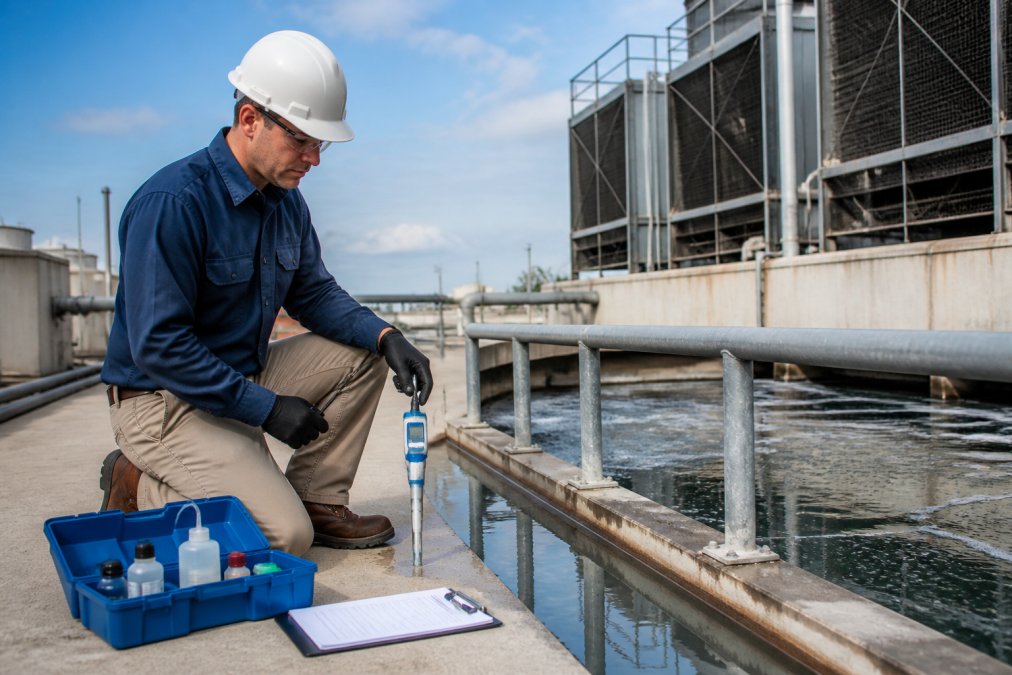
Monitoring is where good water chemistry either holds or falls apart. A treatment program is only as strong as the testing routine behind it.
A practical monitoring schedule for most cooling systems:
- Daily: pH, conductivity, and biocide residual
- Weekly: alkalinity, hardness, and inhibitor concentration
- Monthly: full water chemistry panel, corrosion coupon inspection
- Quarterly: deposit analysis, treatment program review
Preventative maintenance beats reactive repair: replacing a fouled heat exchanger or repairing a corroded basin costs far more than the labor hours spent testing and adjusting chemistry.
What Long-Term Degradation Actually Looks Like
Most content on this topic is theoretical. The useful version is the physical evidence you find when a loop has drifted out of spec for months or years, that evidence tells you whether your program is working.
A common pattern across facilities that run without disciplined testing:
- Months 1-6 (pH drifting low, 6.0-6.8): No visible change. Corrosion coupons show a modest weight loss that gets dismissed as normal. The passivation film is thinning but the loop still looks clean.
- Months 6-18: Coupon weight loss accelerates. Copper surfaces develop a dull, slightly pink cast as the protective carbonate film gives way. Mild steel begins to show localized pitting rather than uniform loss, the more dangerous pattern, because pits penetrate faster than the average rate suggests.
- Months 18-36: First pinhole leaks appear, usually at threaded joints, weld heat-affected zones, and low-flow dead legs where dissolved oxygen and chlorides concentrate. Heat exchanger tubes show under-deposit corrosion beneath any scale that formed.
- Beyond 36 months: Basin steel shows tuberculation, raised, rust-colored nodules over pits. Gasket and seal materials harden and crack. The loop is now in reactive-repair mode, and the cost curve inverts: you are spending more on emergency repairs than you ever saved by skipping testing.
The high-pH version of the same story looks different. Aluminum and galvanized components show white or gray corrosion product (zinc or aluminum hydroxide) rather than red rust. Gaskets swell and degrade faster. Calcium carbonate scale builds on hot surfaces, and the efficiency loss shows up as rising condenser approach temperatures before any leak appears.
Corrosion Coupons and Deposit Analysis: The Early Warning System
Corrosion coupons are the most underused diagnostic tool in cooling water treatment. A coupon is a small, weighed strip of the same metallurgy as your loop, mounted in a bypass rack where it sees the same water. Pull it monthly, clean it, weigh it, and calculate a corrosion rate in mils per year (mpy).
Typical industry guidance treats rates under roughly 1-2 mpy for carbon steel and under about 0.1-0.2 mpy for copper alloys as acceptable, though the exact target depends on your treatment program and equipment value. The trend matters more than any single reading: a coupon that goes from 0.5 mpy to 3 mpy over three months is telling you something changed in the water, even if the pH reading looks fine.
Deposit analysis goes a step further. When you pull a fouled tube or basin sample, a lab can tell you whether the deposit is calcium carbonate (scale), iron oxide (corrosion product), biological film, or a mix. That distinction determines the fix. Dosing more scale inhibitor into a system that is actually corroding wastes money and can make the problem worse.
Bridging Hobbyist and Industrial Protocols
There is a real disconnect between the PC water-cooling hobbyist and the industrial cooling tower operator, and the two groups can learn from each other. A hobbyist running a closed loop with a distilled-water-and-biocide mix is essentially running a miniature closed-loop system: the same passivation chemistry applies, the same aluminum-versus-copper tension exists in a mixed-metal block and radiator setup, and the same pH drift from galvanic corrosion shows up as cloudy coolant and slime.
The difference is scale and consequence. A hobbyist can flush and refill every six to twelve months and call it maintenance; an industrial operator running thousands of gallons per day cannot, because water cost, downtime, and regulatory discharge requirements make continuous chemical treatment the only viable path. But the principles are identical: hobbyists who understand buffer capacity and material compatibility make better coolant choices, just as industrial operators who understand the distilled-water baseline know what "clean" makeup water means.
Preventative Maintenance Beats Reactive Repair
Long-term degradation is the quiet risk: systems that run "fine" for years without testing tend to fail suddenly when a threshold is crossed. Corrosion coupons and periodic deposit analysis catch the slide before it becomes a shutdown. The operators who avoid the failure curve are not the ones with the most sophisticated program, they test consistently, log results, and act on trends rather than waiting for an alarm.
Conclusion
Cooling system chemistry is unforgiving. pH drifts, alkalinity depletes, and scale accumulates whether or not anyone is watching, and the consequences are efficiency loss, equipment damage, and unplanned downtime. Operators who stay ahead of it treat water quality as a core operational metric, not an afterthought.
For facilities that need a dependable source of high-volume alkaline water, Our True North, LLC offers a pickup-based supply model built around consistent quality, volume capacity, and a schedule that fits your operation.
Get a free estimate from Our True North, LLC.
Frequently Asked Questions
What is the recommended pH range for industrial cooling tower water?
Most cooling tower systems operate best between pH 6.5 and 8.5, with many facilities targeting 7.5 to 8.2 to balance corrosion control and scale prevention. Alkaline water for cooling systems typically falls in the upper part of this range. Always check your equipment manufacturer's guidelines, because materials like copper and aluminum have narrower tolerances. Regular testing with a calibrated pH meter ensures you stay within safe limits and avoid costly damage.
Can alkaline water prevent scaling in closed-loop cooling systems?
Alkaline water alone does not prevent scaling. In fact, high pH combined with hard water minerals can accelerate scale formation. Scaling prevention in cooling systems requires controlling total dissolved solids, conductivity, and mineral content through treatment methods like ion exchange, demineralization, or chemical inhibitors. Alkaline water can be part of the solution when it is demineralized or softened first. Test your water source and consult a treatment specialist before relying on pH alone.
What is the difference between alkaline water and softened water for cooling?
Alkaline water has a pH above 7.0, while softened water has had calcium and magnesium removed through ion exchange. Softened water reduces scale potential but may be slightly acidic or neutral. Alkaline water can help buffer pH swings and inhibit corrosion, but it may still contain minerals that cause scale. For cooling systems, the best approach often combines softening or demineralization with pH adjustment. High volume alkaline water supply services can provide consistent quality for large operations.
How does alkaline water affect corrosion rates in cooling systems?
Alkaline water can reduce corrosion in certain metals by forming a protective oxide layer, especially on steel and copper alloys. However, extremely high pH (above 9.0) can accelerate corrosion in aluminum and galvanic couples. The key is staying within the recommended range for your specific materials. Regular monitoring of pH, conductivity, and corrosion coupons helps you track performance. Cooling tower water treatment chemicals can fine-tune pH and add inhibitors for extra protection.