 how-to
Ensuring Water Supply for Data Centers: A 2026 Guide
Table of Contents
- Why Water Supply Matters for Data Center Operations
- Understanding Data Center Water Use Efficiency (WUE)
- Bulk Water Supply for Industrial Operations
- Cooling Technologies and Water Consumption
- Emergency Water Supply Planning for Data Centers
- Regulatory Compliance and Water Rights
- Implementing a Sustainable Water Strategy
- Frequently Asked Questions
Last Updated: September 3, 2026
Why Water Supply Matters for Data Center Operations
Data centers consume enormous quantities of water for cooling, the single largest operational expense. Without a reliable water supply strategy, your facility faces downtime, equipment failure, and regulatory penalties. Water stress is increasing across regions while regulatory frameworks tighten and demand for data center capacity grows. Water supply planning is now a strategic priority that belongs in capital planning and operational risk assessment.
Understanding Data Center Water Use Efficiency (WUE)
Water use effectiveness measures how efficiently a data center converts water into cooling capacity. WUE is calculated as liters of water consumed per kilowatt-hour of IT equipment power. Understanding your WUE baseline is the first step toward ensuring water supply that scales with growth.
Measuring WUE and Setting Baselines
Start by auditing your current water sources and tracking consumption by end use: cooling towers, closed-loop systems, immersion cooling, equipment maintenance, and sanitation. This granularity reveals where consumption concentrates and where efficiency gains have the highest impact. Many operators discover their baseline measurement is incomplete, missing facility maintenance water or evaporative loss. Once you establish a complete baseline, you can set realistic targets and identify which technologies deliver the greatest improvement.
Benchmarking Against Industry Standards
Facilities using traditional air cooling typically operate at WUE levels between 1.8 and 2.2 liters per kilowatt-hour (peer-reviewed research). Facilities with optimized evaporative cooling, hybrid approaches, and water recycling can achieve WUE below 1.0. This gap represents millions of gallons annually and translates directly to operational cost and environmental impact. Benchmarking identifies which water efficiency investments make financial sense and connects you with peer facilities facing similar regional constraints.
Bulk Water Supply for Industrial Operations
Bulk water supply requires a fundamentally different approach than municipal service. Municipal systems cannot guarantee the volume your facility requires during peak demand periods, particularly in water-stressed regions.
Selecting the Right Supply Model
Three primary supply models exist: municipal connection, on-site sourcing, and bulk delivery. Municipal supply offers reliability and regulatory simplicity but often cannot meet peak demand. On-site sourcing through wells provides independence but requires years of permitting and faces regulatory restrictions on groundwater withdrawal. Bulk water delivery through reliable local suppliers like Our True North, LLC offers a middle path, eliminating capital and permitting burden while providing flexibility that municipal systems cannot. A pickup-based delivery model lets your facility control when water is collected, matching supply to actual demand cycles.
Ensuring Consistent Volume During Peak Demand
Peak demand periods create the greatest supply risk. Summer cooling loads spike, maintenance schedules cluster, and emergencies demand large quantities on short notice. Redundancy is fundamental: no single supply source should represent your entire water intake. The most resilient approach combines multiple sources, primary supply from municipal connection for baseline operations, secondary supply from bulk water delivery for surge capacity, and tertiary supply from on-site storage or emergency agreements.
Storage capacity amplifies the value of multiple supply sources. A 50,000-gallon storage tank absorbs short-term interruptions and smooths demand spikes. Storage also enables flexible pickup schedules with bulk suppliers, letting you collect water when convenient rather than requiring just-in-time delivery.
Cooling Technologies and Water Consumption
Cooling technology selection drives water consumption more than any other factor. Understanding the water implications of each approach is essential to ensuring water supply that remains viable as conditions tighten.
Evaporative Cooling and Water Loss
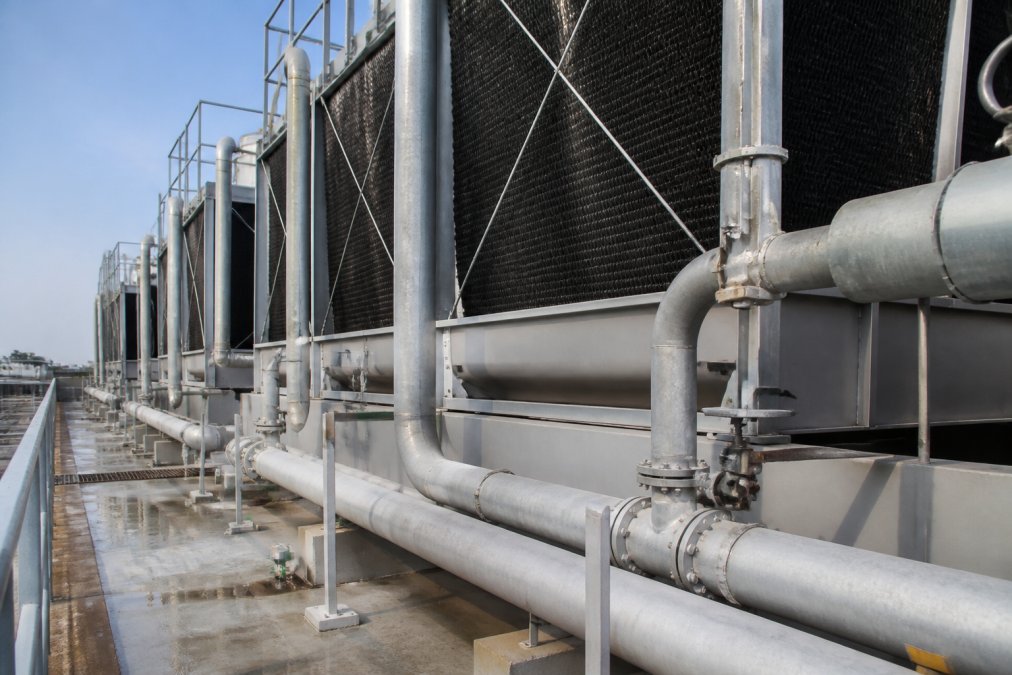
Evaporative cooling works by passing air through water-saturated media, allowing evaporation to absorb heat. The evaporated water is lost to the atmosphere. A typical evaporative cooling tower handling 10 megawatts of heat load might consume 200,000 gallons per day during peak operation (the EPA). Beyond evaporative loss, cooling towers require blowdown water to prevent scale buildup, adding 20 to 40 percent to total consumption depending on incoming water quality.
Evaporative cooling is efficient in dry climates but becomes untenable in water-stressed areas. Relying entirely on evaporative cooling in regions where water availability is declining creates strategic vulnerability.
Closed-Loop and Immersion Cooling Alternatives
Closed-loop cooling systems recirculate water through sealed circuits without evaporative loss. A facility using closed-loop cooling for the same 10-megawatt heat load might consume only 10,000 to 20,000 gallons daily for makeup water and maintenance. The trade-off is electrical consumption: chillers are energy-intensive. In regions where water is scarce and electricity is relatively cheap, closed-loop systems make economic sense despite higher energy use.
Immersion cooling represents the frontier of water efficiency. Equipment is submerged in dielectric fluid, with heat transferring directly to the coolant. This efficiency translates to lower circulation rates and minimal water consumption, sometimes approaching zero for makeup water. However, immersion cooling requires equipment redesign and remains less common than evaporative or closed-loop approaches in existing facilities.
Emergency Water Supply Planning for Data Centers
Emergencies expose gaps in routine planning. A water main break, wildfire contamination, or equipment failure at your supplier can create sudden shortage. Ensuring water supply requires planning for scenarios where normal supply chains fail.
Building Redundancy Into Your Water Strategy
Redundancy means having multiple independent supply sources, each capable of meeting critical needs independently. The first layer is supply source diversity: if you depend on municipal water, add bulk water delivery from a local supplier like Our True North, LLC. The second layer is on-site storage: a 100,000-gallon storage tank provides a buffer against short-term interruptions. The third layer is demand flexibility: categorize water uses by criticality so you can maintain essential cooling even if total supply drops.
Response Protocols During Supply Disruptions
When supply interruption occurs, response must be immediate and predetermined. Your emergency water supply plan should specify who has authority to declare emergency, which water uses are suspended first, which facilities are prioritized, how long you can operate on emergency supplies, and communication protocols with suppliers. Testing your emergency protocols annually is non-negotiable: run tabletop exercises to identify gaps and verify that backup suppliers can deliver what you expect.
Regulatory Compliance and Water Rights
Water rights and regulatory frameworks vary dramatically by region and are tightening across most areas. In the United States, eastern states follow riparian rights doctrine while western states follow prior appropriation doctrine. Texas, where Our True North, LLC operates, follows the rule of capture for groundwater, though this rule is evolving as depletion accelerates.
Regulatory agencies increasingly require water withdrawal permits and impose restrictions on consumption. Your facility should conduct a water rights and regulatory audit with legal counsel to identify available water sources, applicable efficiency standards, reporting requirements, restrictions during drought, and penalties for non-compliance. Regulatory frameworks are evolving rapidly, so your strategy should include monitoring of trends and flexibility to adapt as rules change.
Implementing a Sustainable Water Strategy
A sustainable water strategy matches consumption to available resources and builds in flexibility as conditions change.
Water Recycling and Reclaimed Water Integration
Water recycling captures water used once and reuses it for a different purpose. Cooling tower blowdown water can be recycled back into the tower after treatment, reducing fresh water demand by 10 to 20 percent. Reclaimed water from municipal wastewater treatment plants is increasingly available and ideal for cooling tower makeup and facility maintenance, preserving potable supply for human consumption while reducing potable water demand by 40 to 60 percent.
The barrier is typically infrastructure and permitting rather than technology. Investment is required upfront, but long-term savings in water cost and operational resilience often justify it.
Monitoring and Continuous Improvement
Implement submetering at major consumption points to reveal patterns and identify anomalies. Establish baselines and set efficiency targets, tracking progress monthly. Benchmark your performance against peer facilities and industry standards. Annual water audits by external specialists identify efficiency opportunities with payback periods of one to three years. Communicate your water strategy and performance to stakeholders to build trust and demonstrate commitment to sustainable operations.
Ensuring water supply for data centers is a strategic challenge touching operations, capital planning, regulatory compliance, and environmental responsibility. Facilities that thrive in a water-constrained future treat water supply as a core operational priority, invest in redundancy, measure consumption rigorously, and adapt technology as conditions change.
Our True North, LLC understands the water supply challenges data center operators face. We provide high-volume, clean alkaline water through a flexible pickup model that gives you control over your supply schedule. Our local Texas operation means we understand the specific water stress conditions you face and can help you build the redundancy and reliability your facility needs. Get a Free Estimate to discuss how our water supply service fits into your facility's resilience strategy.
Frequently Asked Questions
How do data centers manage water consumption for cooling systems?
Data centers use several cooling methods, with evaporative cooling being the most water-intensive. Cooling towers circulate water to absorb heat from servers, with some water lost through evaporation. Advanced facilities employ closed-loop systems and immersion cooling to reduce water withdrawal. Water use effectiveness (WUE) measures the ratio of water consumed to IT equipment output, helping operators track efficiency. Recirculation systems and reclaimed water integration further reduce freshwater demand while maintaining thermal management performance.
What is water use effectiveness (WUE) and why does it matter for data center operations?
Water use effectiveness (WUE) measures liters of water consumed per kilowatt-hour of IT equipment output. It provides a standardized metric for comparing water efficiency across facilities and tracking improvement over time. Lower WUE values indicate more efficient operations. Most data centers track WUE alongside Power Usage Effectiveness (PUE) to understand their full resource footprint. Monitoring WUE helps identify opportunities to reduce water consumption without sacrificing cooling performance or uptime.
What happens if a data center's water supply is interrupted during peak demand?
Water supply disruptions can force immediate equipment shutdown to prevent thermal damage, resulting in costly downtime. Emergency water supply planning mitigates this risk through redundant supply agreements, on-site storage capacity, and backup sources like reclaimed water systems. Facilities should establish response protocols that identify alternative suppliers, define activation triggers, and maintain communication channels with water providers. Building resilience into your supply chain prevents emergency situations from becoming operational crises.
What regulatory standards govern water usage for data center operations?
Data center water usage is governed by state and local water rights regulations, environmental protection standards, and local watershed management rules. The EPA establishes guidelines for industrial water withdrawals and wastewater discharge. Many regions require facilities to obtain water permits that specify allowable withdrawal volumes and seasonal restrictions. Compliance depends on your location and local water stress conditions. Consult with your state's water authority and local environmental agencies to understand obligations specific to your facility's jurisdiction.
This article was written using GrandRanker
Frequently Asked Questions
How do data centers manage water consumption for cooling systems?
Data centers use several cooling methods, with evaporative cooling being the most water-intensive. Cooling towers circulate water to absorb heat from servers, with some water lost through evaporation. Advanced facilities employ closed-loop systems and immersion cooling to reduce water withdrawal. Water use effectiveness (WUE) measures the ratio of water consumed to IT equipment output, helping operators track efficiency. Recirculation systems and reclaimed water integration further reduce freshwater demand while maintaining thermal management performance.
What is water use effectiveness (WUE) and why does it matter for data center operations?
Water use effectiveness (WUE) measures liters of water consumed per kilowatt-hour of IT equipment output. It provides a standardized metric for comparing water efficiency across facilities and tracking improvement over time. Lower WUE values indicate more efficient operations. Most data centers track WUE alongside Power Usage Effectiveness (PUE) to understand their full resource footprint. Monitoring WUE helps identify opportunities to reduce water consumption without sacrificing cooling performance or uptime.
What happens if a data center's water supply is interrupted during peak demand?
Water supply disruptions can force immediate equipment shutdown to prevent thermal damage, resulting in costly downtime. Emergency water supply planning mitigates this risk through redundant supply agreements, on-site storage capacity, and backup sources like reclaimed water systems. Facilities should establish response protocols that identify alternative suppliers, define activation triggers, and maintain communication channels with water providers. Building resilience into your supply chain prevents emergency situations from becoming operational crises.
What regulatory standards govern water usage for data center operations?
Data center water usage is governed by state and local water rights regulations, environmental protection standards, and local watershed management rules. The EPA establishes guidelines for industrial water withdrawals and wastewater discharge. Many regions require facilities to obtain water permits that specify allowable withdrawal volumes and seasonal restrictions. Compliance depends on your location and local water stress conditions. Consult with your state's water authority and local environmental agencies to understand obligations specific to your facility's jurisdiction.