 listicle
Best Bulk Water Supply Alternatives for Industrial Use
Table of Contents
- Quick Comparison: Bulk Water Supply Alternatives
- Uph2o Alternative for Data Centers: What to Look For
- Our True North, LLC: High-Volume Alkaline Water Pickup
- Twin Rocks Natural Spring Water: Scheduled Delivery for Offices
- GENAQ Atmospheric Water Generators: Off-Grid Independence
- EZ H2O Bulk Water Delivery: Rapid Response for Emergencies
- Industrial Bulk Water Supply Logistics: Delivery vs. Pickup
- On-Site Water Storage Best Practices for Industrial Facilities
- Frequently Asked Questions
Last Updated: September 12, 2026
Quick Comparison: Bulk Water Supply Alternatives
Finding the best bulk water supply alternatives starts with matching the source to your operation's volume, timeline, and quality requirements. Industrial facilities across Texas face a common problem: municipal lines cap out, delivery windows slip, and emergency demand spikes expose how thin the backup plan really is. This guide from Our True North, LLC breaks down pickup, delivery, atmospheric generation, and on-site storage so you can pick a supply model that holds up under pressure.
The comparison below covers the main options available to data centers, construction sites, and industrial plants, with the tradeoffs that matter most.
| Supply Option | Best For | Delivery Model | Key Limitation |
|---|---|---|---|
| Our True North, LLC | High-volume alkaline water, critical sites | Pickup | Pickup-based only |
| Twin Rocks Natural Spring Water | Offices needing scheduled drinking water | Subscription delivery | Restricted service area |
| GENAQ Atmospheric Water Generators | Off-grid or remote locations | On-site generation | High upfront capital cost |
| EZ H2O Bulk Water Delivery | Emergency and rapid-response needs | Per-delivery tanker | Regional zones only |
| Water Transport | Compliant industrial supply | Per-delivery tanker | Needs large-truck site access |
Each option solves a different problem. The sections below explain which one fits your facility.
Uph2o Alternative for Data Centers: What to Look For
Data centers need a bulk water supply that never interrupts cooling or facility maintenance. When evaluating an Uph2o alternative for data centers, prioritize three things: volume consistency, water quality documentation, and a supply model that does not depend on a third-party delivery schedule you cannot control.
An atmospheric water generator is a legitimate fit for remote sites, but the capital cost is steep and output depends on humidity. For most data centers, the practical choice is a local high-volume source with a pickup model, which removes the delivery-window risk entirely.
U.S. Environmental Protection Agency water quality standards
Our True North, LLC: High-Volume Alkaline Water Pickup
Our True North, LLC is a strong option for industrial operations that prioritize efficiency and reliability. Based in Rising Star, Texas, the company supplies high-volume alkaline water through a simple pickup process, which means you control the schedule instead of waiting on a route.
What sets it apart is the combination of volume and consistency. Facilities get reliable water access for high-volume users, consistent water quality across every order, and a flexible pickup schedule that fits around shift changes and maintenance windows. The tradeoff is honest: pickup requires your team to handle transport, so it suits operations that already run their own tanker or truck fleet.
Twin Rocks Natural Spring Water: Scheduled Delivery for Offices
Twin Rocks Natural Spring Water is built for scheduled, recurring delivery rather than industrial surge demand. The service runs on subscription routes with bulk container options, and it earns strong customer satisfaction for keeping those routes consistent.
Where it falls short is geography. The service area is restricted, so facilities outside the covered zone are out of luck. For an office that needs dependable drinking water on a predictable calendar, it works well. For a plant that needs thousands of gallons on short notice, it is the wrong tool.
GENAQ Atmospheric Water Generators: Off-Grid Independence
GENAQ Atmospheric Water Generators extract water from ambient air, giving a site a self-replenishing supply that does not touch a municipal line. For locations where traditional delivery is logistically difficult, that independence is genuinely valuable, but the decision should be made on operating math, not on the appeal of going off-grid.
How the mechanism actually works. An AWG pulls air across a cooled condenser coil, drops the air below its dew point, and collects the condensate. That condensate is then pushed through sediment and carbon filtration, and typically a UV or ozone stage, before it is stored. The practical consequence: output is a function of relative humidity and ambient temperature, not of how much water you ordered. A unit rated for a given daily output at high humidity will produce a fraction of that in dry, hot conditions, and performance swings seasonally.
The costs competitors skip. The purchase price is only the entry ticket. The recurring line items are:
- Electricity. Condensation is energy-intensive. A common pattern is that power draw scales roughly with daily output, so a unit producing a few hundred gallons per day can add meaningfully to a facility's electrical load. In high-demand periods, that cost lands on the same bill as cooling.
- Filter and lamp replacement. Sediment, carbon, and UV components have service intervals measured in months, not years. Budget for a standing replacement schedule.
- Coil and condenser cleaning. Dust, pollen, and mineral scale degrade output. Most practitioners find that a quarterly cleaning cadence is the minimum in dusty environments.
- Storage and post-treatment. The unit feeds a tank, and that tank needs the same rotation, testing, and labeling discipline as any other stored water.
Space and infrastructure. An AWG is not a drop-in appliance. Plan for the unit footprint plus clearance for airflow and service access, a dedicated electrical circuit, a condensate drain or collection point, and a treated-water storage tank sized to your buffer requirement. On a tight industrial pad, that footprint competes directly with storage and process equipment.
When the math favors it. If your site has no reliable delivery access, no municipal connection, and can absorb both the capital and the ongoing power and filter costs, atmospheric generation removes the dependency entirely. If delivery is available at a reasonable per-unit cost, the operating math rarely favors an AWG for bulk volume, it is best treated as a resilience layer or a remote-site solution, not a primary bulk supply.
U.S. Department of Energy guidance on industrial energy use
EZ H2O Bulk Water Delivery: Rapid Response for Emergencies
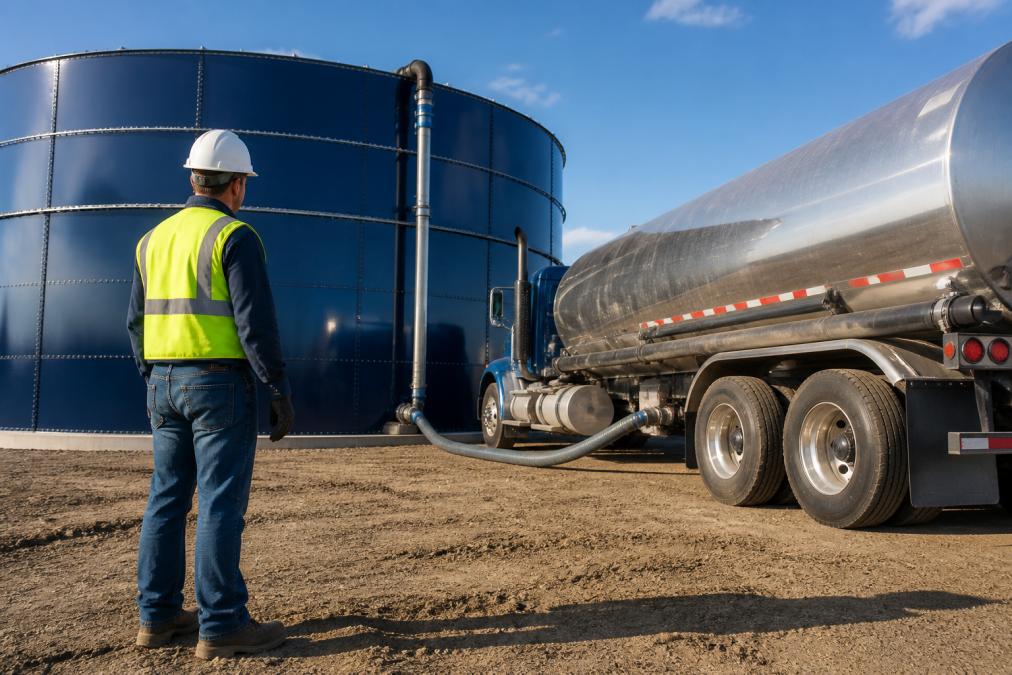
EZ H2O Bulk Water Delivery specializes in speed. The service runs large-capacity tanker trucks with potable water certification and focuses on rapid turnaround for industrial and residential applications.
That speed comes with a boundary: service is limited to specific regional zones. For emergency water needs and large-volume industrial requirements inside those zones, it is a strong option. Outside them, you need a different plan.
Industrial Bulk Water Supply Logistics: Delivery vs. Pickup
Industrial bulk water supply logistics come down to one question: do you want to own the schedule or outsource it? Delivery is convenient but introduces a dependency on route timing and driver availability. Pickup trades that convenience for control.
| Factor | Delivery | Pickup |
|---|---|---|
| Schedule control | Provider-dependent | Fully yours |
| Emergency response | Limited by route capacity | Immediate |
| Site requirements | Large-truck access | Your own transport |
| Per-unit cost | Higher, includes transport | Lower |
For facilities with their own fleet, pickup wins on both cost and reliability. For sites without transport, delivery remains the practical choice.
On-Site Water Storage Best Practices for Industrial Facilities
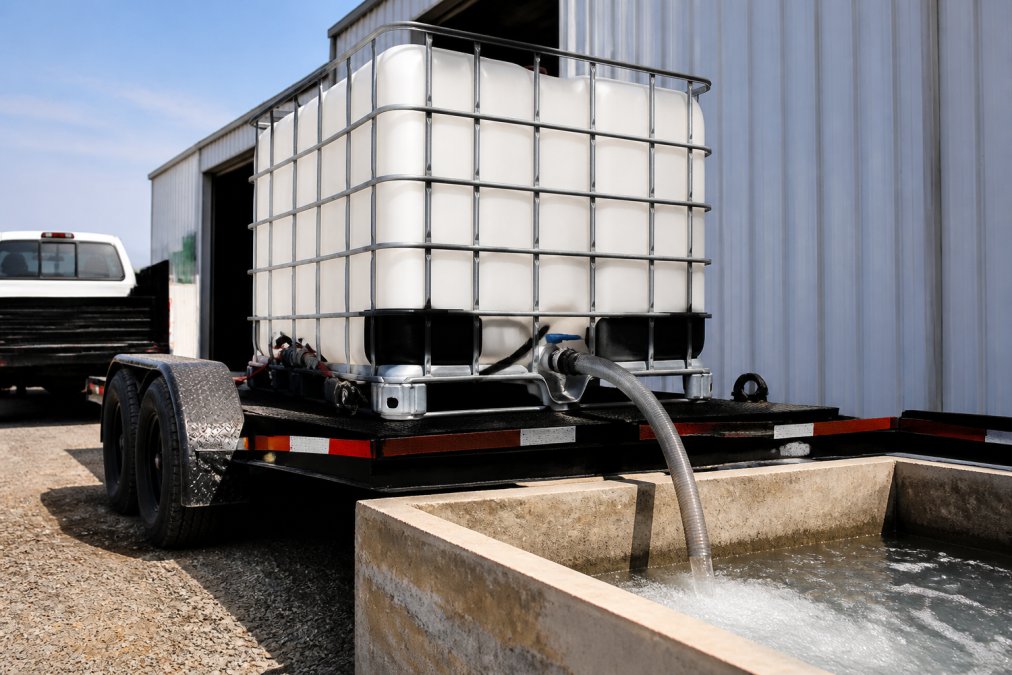
On-site water storage best practices protect you when supply is interrupted. A bulk storage buffer of IBC containers or fixed tanks keeps operations running through a missed delivery or a demand spike. But sizing, siting, and maintaining that buffer is where most guides stop short, and where the real cost and compliance risk lives.
Sizing: start from peak, not average. Size storage for at least three days of peak demand, not average use. If your peak draw is driven by cooling, process, or a shift-change surge, use that number. A buffer sized to average use will empty on the worst day, which is the only day it matters.
Tank type and footprint. The two common choices trade space against flexibility:
- IBC totes. Typically around 275 or 330 gallons each. They are stackable and movable, which makes them useful for temporary or expanding sites, but they need a level pad, secondary containment, and clearance for a forklift or pallet jack. A bank of totes takes more floor area per gallon than a fixed tank.
- Fixed tanks. A 250-gallon tank has a small footprint but limited buffer; larger fixed tanks scale more efficiently per gallon but require a permanent pad, anchoring, and often a concrete or compacted base. Above a certain size, expect to need engineering review and possibly a permit.
A practical rule: map your available pad area first, then choose the tank type that fits, rather than buying tanks and finding space afterward.
Regulatory and zoning compliance, the gap most guides miss. Storage and sourcing rules are local, and they vary by jurisdiction:
- Rainwater harvesting. Many states and municipalities have specific rules on collection, storage, and use, and some restrict potable use without treatment and testing. Check your state and county before you plumb a collection system into a potable line.
- Private wells. Well construction, setback distances, and testing requirements are typically governed at the state level, with county health departments enforcing. A well that is fine for irrigation may not be approved for potable use without treatment.
- Storage tanks. Above-ground tank placement can trigger zoning setbacks, fire-code clearances, and secondary-containment requirements, especially near waterways or storm drains.
- Backflow prevention. Any connection between a private supply and a municipal line requires an approved backflow prevention assembly and, in most jurisdictions, annual testing by a certified tester.
Maintenance and long-term operating costs. The setup cost is the visible number; the recurring cost is the one that surprises facilities:
- Rotation. Rotate stored water on a fixed schedule to prevent stagnation. Stagnant water is a biological risk regardless of source quality.
- Testing. Test stored water quality on a set cadence, monthly is a common baseline for potable storage, not only after complaints.
- Cleaning. Tanks need periodic draining, inspection, and disinfection. IBCs are harder to clean thoroughly than smooth-walled fixed tanks, which is a hidden labor cost.
- Seals and vents. Keep fill connections and tank vents sealed against contaminant intrusion; a failed gasket is a common contamination path.
- Labeling. Label every tank with fill date and source for traceability, which also supports any audit or compliance review.
Post-treatment. A filtration system or reverse osmosis stage between storage and use adds a final contaminant barrier. Pair storage with a documented maintenance schedule and your facility gains real water security, and a defensible record if a regulator or insurer asks how the supply is managed.
CDC guidance on emergency water storage and treatment
U.S. Environmental Protection Agency drinking water regulations
Frequently Asked Questions
How do on-site pickup models compare to traditional bulk water delivery?
Pickup models eliminate delivery scheduling delays and give you control over timing. You drive to the source, fill your containers, and return to your site without waiting for a truck. This works well for operations that can plan ahead and have their own transport. Delivery services remain better for emergency response or sites without vehicles. The best bulk water supply alternative depends on your volume, location, and how much flexibility you need.
What factors should data centers consider when choosing a bulk water supply?
Data centers need consistent volume, reliable quality, and no downtime. Look for a provider with certification for potable or industrial-grade water, capacity to handle peak summer demand, and a backup plan if your primary source fails. An Uph2o alternative for data centers should also offer flexible scheduling and clear water quality testing reports. Space for on-site storage and truck access also matter.
Are there cost-effective alternatives to scheduled bulk water delivery?
Yes. Self-pickup from a local supplier can be a cost-effective alternative to delivery, as it avoids transport fees. Atmospheric water generators have high upfront costs but can reduce ongoing delivery expenses. Rainwater harvesting and graywater reuse can reduce utility costs for non-potable applications. For drinking water, pickup or subscription delivery often balances cost and convenience effectively.
What are the most reliable bulk water alternatives for industrial sites?
Industrial sites typically choose between pickup services, tanker delivery, atmospheric water generators, and on-site storage with filtration. Pickup from a high-volume source like Our True North, LLC works well for scheduled needs. Tanker delivery suits emergency fill-ups. AWGs provide independence but require capital investment. The most reliable option is one with a proven track record in your region and a maintenance schedule you can follow.
How does alkaline water quality impact industrial equipment longevity?
Alkaline water with controlled pH can reduce scale buildup in cooling systems and boilers compared to hard water. Lower mineral content means fewer deposits on heat exchangers and pipes, which extends equipment life and cuts maintenance costs. For data centers using water for cooling, consistent quality testing and filtration are essential. Always verify the water meets your equipment manufacturer's specifications for pH and conductivity.
Industrial operations cannot treat water supply as a background utility. When demand spikes or a delivery fails, the facilities with a controlled source and a storage buffer keep running, and everyone else scrambles. Our True North, LLC supplies high-volume alkaline water through a simple pickup process, backed by consistent water quality and a flexible pickup schedule built for demanding sites. Get a free estimate from Our True North, LLC and lock in a supply you actually control.